

Quick Summary
Dainty gold jewellery suits everyday wear because its fine chains and small pendants stay out of the way under clothing, layer easily and feel comfortable for hours. Its resistance to tarnish depends on construction: stainless steel with a PVD gold finish holds up well to daily wear, while plated pieces wear through faster.
- Gold-filled pieces can last one to five years of daily wear, according to Atolea Jewellery.
- Gold-plated jewellery has a thin gold layer that wears through with friction, sweat and water.
- Solid gold keeps its colour, so care focuses on avoiding scratches and keeping it clean.
- Take jewellery off before showering, swimming, exercising and applying perfume or lotion.
- Patch-test a new piece on the wrist or one earlobe if you have a known sensitivity.
Table of Contents
- Why Dainty Gold Jewellery Suits Everyday Wear
- What Tarnish-Free Really Means in Gold Jewellery
- Gold-Plated vs Gold-Filled Jewellery: How They Wear Over Time
- Gold Vermeil vs Gold Plating: What the Difference Means for Longevity
- Stainless Steel Gold Jewellery and Sensitive Skin
- How to Care for Gold Jewellery So It Keeps Its Shine
- Choosing Your Next Dainty Piece at JustEden
- Frequently Asked Questions
Why Dainty Gold Jewellery Suits Everyday Wear
Dainty gold jewellery earns its place in daily routines because it stays out of the way. A fine chain or a small bar pendant sits quietly under a work shirt, layers well with other pieces, and never snags on a jumper or clashes with a laptop bag. For professional women who wear the same jewellery from morning meetings to evening plans, that quiet versatility matters more than a bold statement piece.
Lightweight construction adds to the appeal. Delicate pieces feel comfortable for hours, which is why many people forget they are wearing them at all. That is the goal for everyday jewellery: it should feel like part of your outfit, not an accessory you have to manage.
At JustEden, we design our dainty pieces around this idea of wearability. The Bar Pendant Necklace, for example, is a slim vertical bar on an adjustable chain, sized to sit at the collarbone or layer over longer necklaces.
What Tarnish-Free Really Means in Gold Jewellery
Tarnish-free is one of the most misunderstood claims in jewellery. Researchers at Tulane University, led by Matthew Montemore, have studied why gold resists tarnish. Their work points out that gold does not tarnish largely because it does not react strongly with oxygen, which is why it keeps its colour where many other metals dull (Tulane University research on why gold resists tarnish).
That explains why solid gold keeps its colour, but it does not mean every gold-look piece is permanent. Most everyday gold jewellery is a base metal with a gold surface. The surface is what you see, and it is the part that wears.
Anti-tarnish jewellery is designed to resist discolouration, yet its finish can still wear down over time. Longevity depends on the piece, how often it is worn, and how it is cared for. Treat "tarnish-free" as a promise about resistance, not a guarantee that the finish will never change.
Gold-Plated vs Gold-Filled Jewellery: How They Wear Over Time
Gold-plated jewellery is a thin layer of gold bonded to a base metal. It looks excellent when new, but the plating is thin and wears through with friction, sweat and water. Once the base shows, the piece often needs replacing.
Gold-filled jewellery uses a much thicker layer of gold bonded to a base metal through heat and pressure. For more on picking a piece for everyday use, read our guide to choosing the right gold necklace for daily wear. It is more tarnish-resistant than standard plating and can last considerably longer with daily wear. Atolea Jewellery notes that gold-filled pieces can last one to five years of daily wear, which shows durability is real but finite (Atolea Jewellery guide to tarnish-resistant gold jewellery).
The practical difference comes down to how you wear the piece. If you want something for occasional wear, plating can work well. If you wear the same chain every day, gold-filled or a higher-quality finish will usually hold up better.
The table below sets out how the main gold finishes compare for everyday wear, based on the differences described above.
| Finish | Construction | Expected wear |
|---|---|---|
| Gold-plated | Thin gold layer on base metal | Wears through with friction and sweat |
| Gold-filled | Thicker gold layer bonded by heat and pressure | One to five years of daily wear |
| Gold vermeil | Sterling silver coated with thicker gold | Gold layer wears with friction and chemicals |
| Solid gold | Gold throughout | Keeps its colour; care is about scratches |
Gold Vermeil vs Gold Plating: What the Difference Means for Longevity
For most buyers, the choice is about expectations. Vermeil suits a more considered purchase you want to keep for years. Plating suits trend-led pieces you may rotate out. Neither is wrong, but matching the finish to how you plan to use the piece avoids disappointment.
Stainless Steel Gold Jewellery and Sensitive Skin
Stainless steel is a popular base for everyday gold-tone jewellery because it resists corrosion and stands up to sweat and moisture. A gold-tone PVD coating on stainless steel gives a warm finish that resists tarnish well. The Gold Satellite Necklace, for instance, uses an 18K PVD gold finish on stainless steel.
It helps to separate three things that are often lumped together as a skin problem. Tarnish is a change in the jewellery itself: the surface dulls, darkens or discolours as it reacts with oxygen, moisture, sulphur compounds, cosmetics and sweat. Metal transfer is a mark left on the skin, usually a grey or black smudge, caused when a base metal such as copper or a copper alloy reacts with sweat and acids on the skin. Irritation is a reaction in the skin itself, such as redness, itching or a rash, and it is more often linked to nickel or other alloying elements than to gold. Green marks sit closest to metal transfer: they are typically caused by a reaction between sweat or moisture and a base metal, not by the gold itself.
That distinction matters because a piece can be tarnish-resistant and still leave a mark, and a piece can leave no mark yet still tarnish.
If you have a known sensitivity, patch-test a new piece before wearing it all day. Wear it for a short period on an area that is easy to monitor, such as the wrist or a single earlobe, and check for redness or itching before committing to a full day. Keep the piece away from broken skin, and stop wearing it if a rash develops rather than assuming it will settle.
How to Care for Gold Jewellery So It Keeps Its Shine
The habits below matter most:
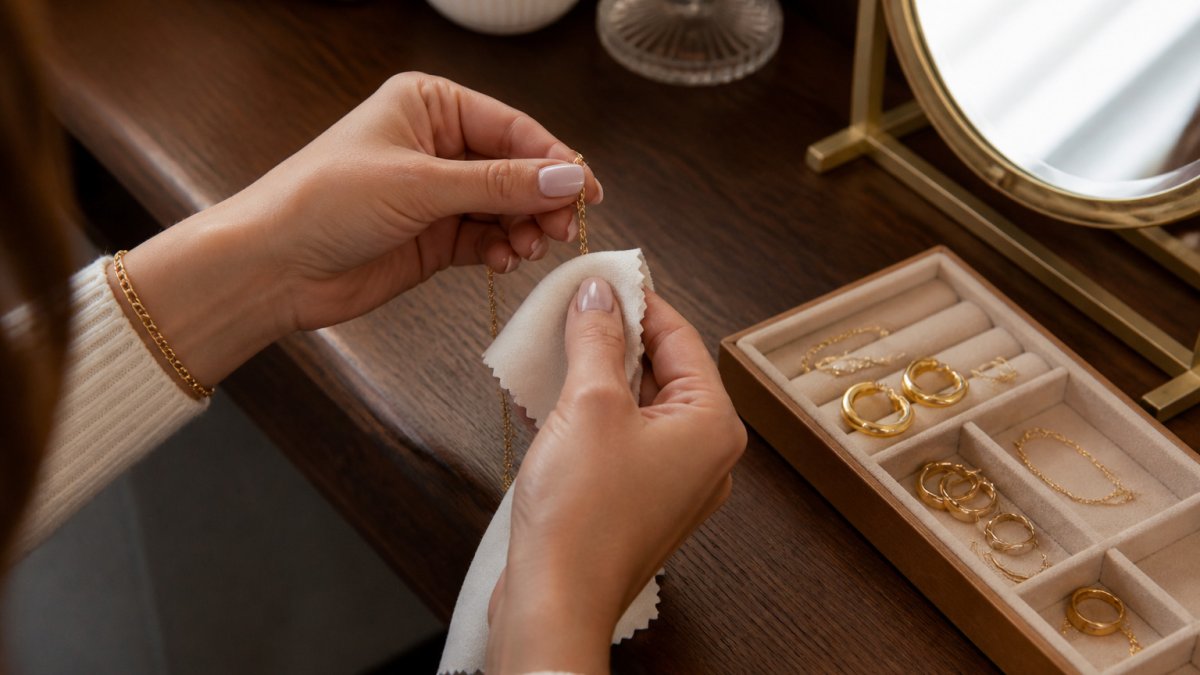
- Take jewellery off before showering, swimming, exercising and applying perfume or lotion, and see whether you can wear a necklace in the shower.
- Wipe pieces with a soft, dry cloth after wearing to remove oils and sweat
- Store chains separately or in a soft pouch so they do not scratch or tangle
- Avoid harsh chemicals, bleach and abrasive cleaners
- Clean with mild soapy water and dry thoroughly if needed
Delicate chains and small settings need extra attention. Gently untangle chains rather than pulling them apart, and check clasps regularly, since a loose clasp is the most common reason for a lost piece. Store fine chains flat or hanging rather than in a loose pile, and fasten the clasp before putting a chain away so it cannot catch on neighbouring pieces. For small settings, avoid ultrasonic cleaners and harsh polishing cloths, which can loosen stones or wear away a thin coating; a soft cloth and mild soapy water are usually enough.
It also helps to understand what you are caring for. Solid gold, gold-filled, vermeil and plated pieces all look similar when new, but they age differently. Solid gold keeps its colour because the metal is gold all the way through, so care is mainly about avoiding scratches and keeping it clean. Vermeil is sterling silver coated with a thicker layer of gold, so the silver base is the key difference from standard plating, and the gold layer still wears with friction and chemical exposure. Standard gold plating uses a thinner coating on a base metal, which is why it can fade faster with frequent contact, perfume or moisture. A realistic comparison of these constructions over time is more useful than treating every product labelled non-tarnish as equivalent.
Our advice in practice is simple: put your jewellery on last and take it off first. Limiting contact with water and chemicals does more for shine than any cleaning routine. When you are buying, check the carat, the base metal, the plating or coating thickness, the clasp and chain construction, and the care instructions, and treat seller claims about tarnish resistance as a starting point rather than a promise.
Choosing Your Next Dainty Piece at JustEden
When you choose a dainty gold piece, start with how you will wear it. Ask whether it will be worn daily or occasionally, whether you shower or exercise in it, and whether you have sensitive skin. Those answers point you toward the right finish and base metal.
Check the materials listed, the finish type and any care guidance. Stainless steel with a PVD gold finish suits daily wear well, while plated or vermeil pieces suit more occasional use. You can browse gold chain link hoop earrings in waterproof, hypoallergenic stainless steel.
For a dainty everyday option, our Bar Pendant Necklace is a tarnish-free stainless steel piece at £32.00, and the Gold Satellite Necklace is available at £29.99 for layering.

Browse the full range and find a piece you will reach for every day. SHOP THE COLLECTION.
Frequently Asked Questions
What type of gold jewellery does not tarnish?
Stainless steel pieces with a gold PVD coating resist tarnishing well.
Is gold-filled jewellery more durable than gold-plated jewellery?
Yes, generally. Gold-filled jewellery has a much thicker layer of gold bonded to a base metal, so it is more tarnish-resistant than standard gold-plated pieces. Research from a gold-filled jewellery maker suggests it can last one to five years of daily wear, although that depends on how often the piece is worn and cared for.
Is dainty gold jewellery suitable for sensitive skin?
JustEden's stainless steel pieces are described as hypoallergenic.
How do you stop gold jewellery from tarnishing?
Remove jewellery before showering, swimming, exercising or applying perfume. Store pieces separately in a soft pouch or lined box to avoid scratches. Wipe them with a soft, dry cloth after wearing to remove oils.

